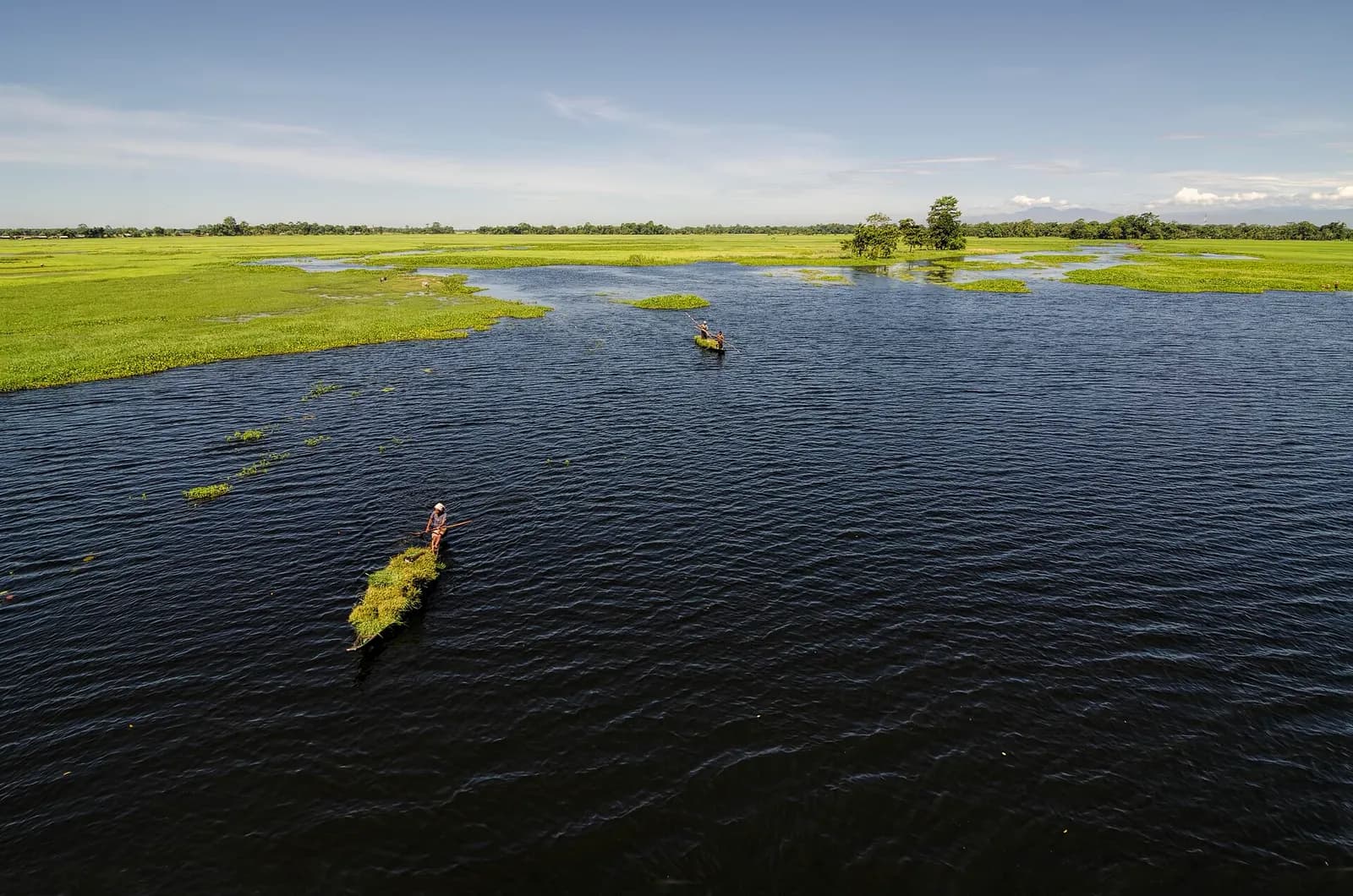
When Srimanta Sankardev and his disciple Madhavdev spread the Ekasarana faith through Assam in the sixteenth century, Majuli became its heart: satras, monastic institutions that teach devotion through drama, dance and song rather than idols, once numbered sixty-five on the island, and twenty-two still function. The island itself is a slab of Brahmaputra silt between the main channel and the Subansiri, once 1,250 square kilometres and now barely 350, gnawed every monsoon by a river that swallows whole villages. That fragility gives Majuli its urgency.
Cross from Nimati Ghat on a ferry stacked with motorbikes and rice sacks, and you land in a world of raised roads through flooded paddy, egrets on buffalo backs and bamboo bridges over channels. At Uttar Kamalabari the celibate bhakats rehearse Sattriya, the classical dance form born here; at Auniati the museum keeps Ahom royal gifts; at Samaguri the Goswami family carves and paints the masks of demons and gods used in bhaona plays, a craft the Padma Shri-winning Hem Chandra Goswami has raised to national fame. Mising villages of stilt houses line the western bank, their women weaving on backstrap looms, their evenings marked by apong poured from bamboo.
In November, Raas Mahotsav turns every satra and village stage into a night-long retelling of Krishna, and the whole island seems to be performing. It is the softest, slowest place in the Northeast, and it may not be here forever.
 Vegetarian