We live here. Our office is a few minutes from the walled city, and most of us do the school run past Albert Hall. So this is not a list of the top ten things to do in Jaipur. It is the way we would send a friend around our own town, in the order that works, with the hours and prices that matter.
The city is a grid, and that helps
Jaipur was founded in November 1727 by Sawai Jai Singh II, an astronomer king who wanted a capital on the plain rather than a fort in the hills. His architect, Vidyadhar Bhattacharya, laid it out as nine squares drawn from the Shilpa Shastras, each square a chowkri with its own trades. Seven gates in the wall, streets 33 metres wide on the main axes, and a right-angled logic you will not find in any other Indian old city.
The famous colour came later. In 1876 the whole town was washed terracotta for the visit of the Prince of Wales, and a municipal order has kept it that way since. UNESCO listed the walled city in 2019. Once you understand the grid, you stop getting lost: Badi Chaupar and Choti Chaupar are the two big crossroads, and everything hangs off the line between them.
Forts, in the right order and at the right hour
Do Amber first and do it early. The gates open at eight, the coaches arrive around ten, and the difference is the entire experience. Walk up the ramp rather than riding an elephant. Inside, the Ganesh Pol leads to the Sheesh Mahal, where thousands of mirror pieces catch a single beam of morning light. Below the fort, Panna Meena ka Kund is a sixteenth-century stepwell of criss-crossing stairs that is usually empty at half past eight.
From Amber, drive fifteen minutes up to Jaigarh, which most people skip. It holds the Jaivana, cast in 1720 and still the largest wheeled cannon in the world, and the view down onto Amber's courtyards explains the whole defensive system. Save Nahargarh for the last hour of daylight. The 1734 fort has nine identical suites built for nine queens, connected by corridors so the maharaja could visit one without the others knowing, and the terrace above them looks straight down on the grid.
The composite ticket, INR 300 for Indian citizens and INR 1,000 for foreign nationals, covers Amber, Nahargarh, Hawa Mahal, Jantar Mantar and Albert Hall for two days, which is better value than paying separately.
Inside the walled city
Jantar Mantar, built from 1734, is an observatory of nineteen masonry instruments. The Samrat Yantra is a 27 metre sundial still accurate to about two seconds, and the small local guides here are genuinely worth the fee, because the instruments mean nothing unlabelled. It opens at nine.
Next door, the City Palace is still the family home of the Jaipur royals in its Chandra Mahal wing. The courtyard to look for is Pritam Niwas Chowk, with four painted doorways for the four seasons: peacock, lotus, green and rose.
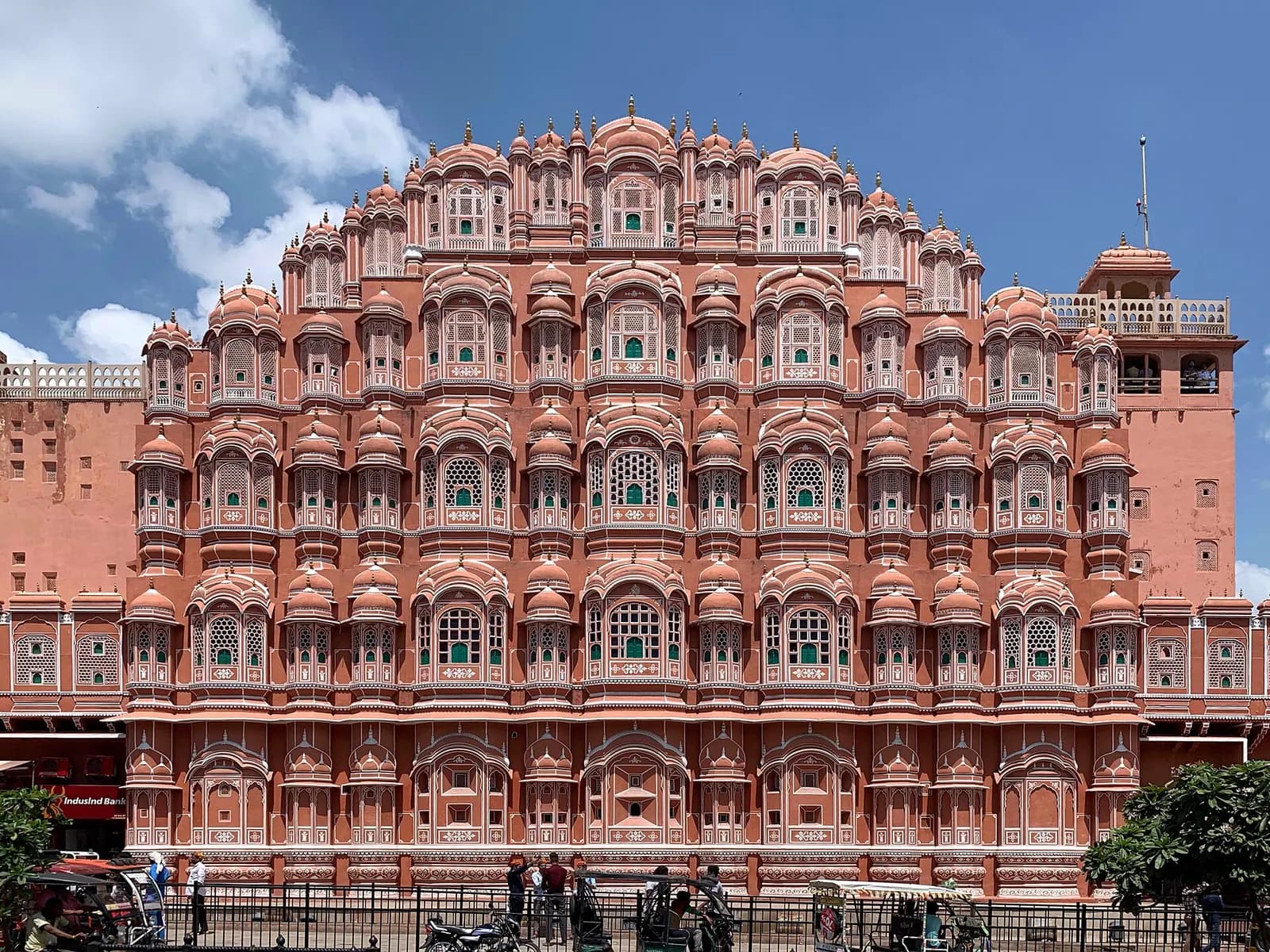
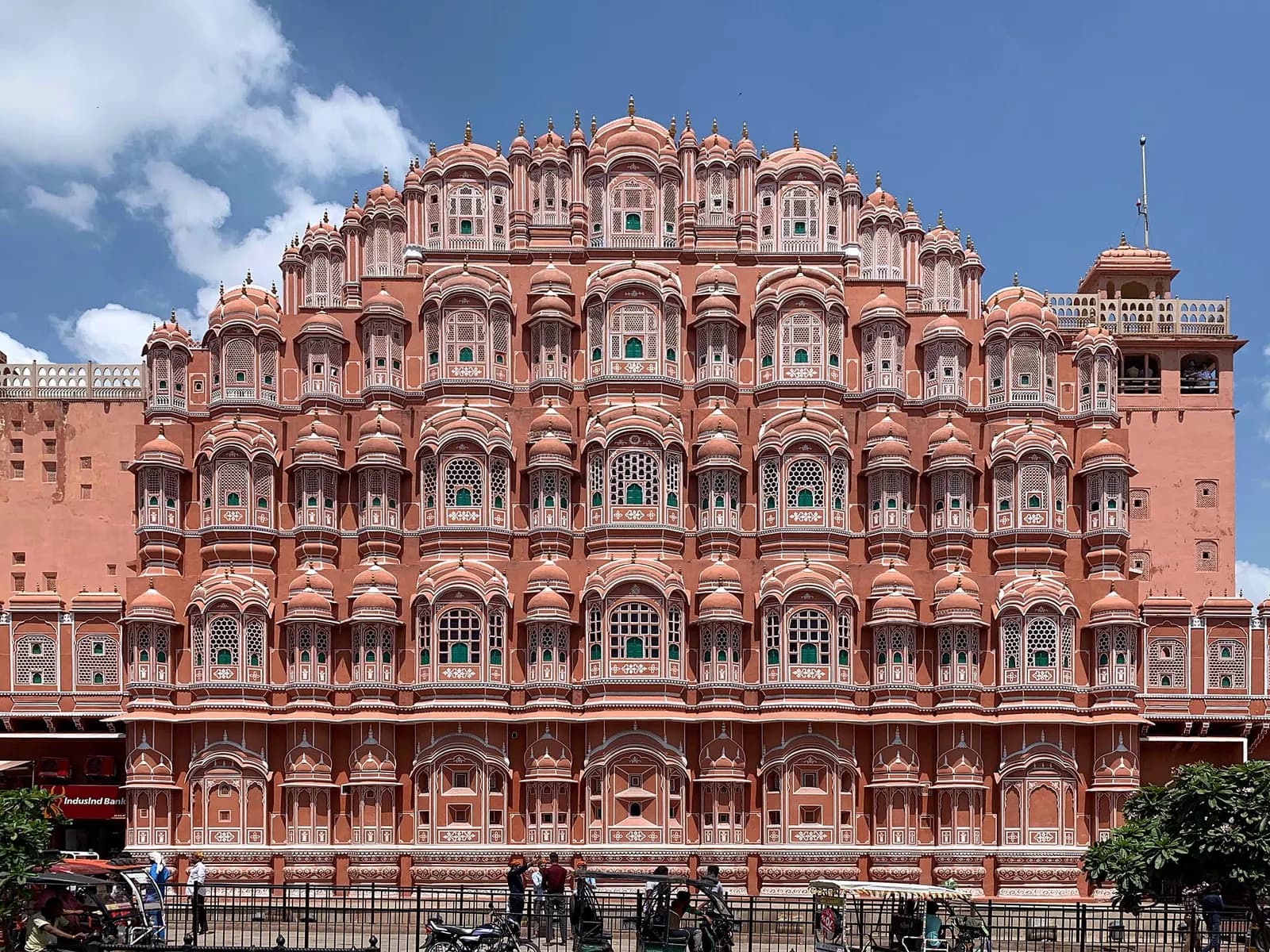
Hawa Mahal is the postcard, five storeys of 953 latticed windows built in 1799 so palace women could watch processions unseen. The entrance is around the back on Hawa Mahal Road, and the honest advice is that the view of it beats the view from it. Cross the street to a rooftop cafe, order chai, and photograph it in early light.
Where Jaipur actually eats
- Pyaaz kachori for breakfast, split open with tamarind chutney, and mawa kachori if you have a sweet tooth. Rawat near Sindhi Camp is the institution.
- Lassi in a clay kulhad on MI Road, thick enough to stand a spoon in. There is a row of near-identical shops; the original has been there since 1944 and shuts when the day's batch runs out.
- Ghewar in Johari Bazaar, the disc-shaped monsoon sweet soaked in syrup, best in Sawan around Teej in August.
- Laal maas, the fiery mutton curry made with Mathania chillies, and dal baati churma with a bowl of ghee poured over it.
- Masala Chowk at Ram Niwas Garden, an open-air court of thirty-odd stalls where INR 300 to 500 gets you a full crawl of chaat, kachori and kulfi in one place.
For a slow evening, the courtyard restaurants in the havelis of the Civil Lines and C-Scheme side of town serve the same Rajasthani food with less noise. Chokhi Dhani, 20 km out on Tonk Road, is a staged village, and it is fun with children and heavy going without them.
Bazaars, crafts and how not to be fleeced
Each bazaar has a specialty. Johari Bazaar is gemstones, kundan and meenakari work; Jaipur cuts more emeralds than anywhere else on earth. Bapu Bazaar is block-printed cotton, jootis and perfume. Tripolia Bazaar leads to Maniharon ka Rasta, where lac bangles are turned over a flame while you wait. Kishanpole is timber and block prints, Chandpole is marble. Almost all of the walled-city bazaars close on Sunday.
Two rules. First, refuse any offer to carry gemstones home for a buyer abroad, however plausible: it is the oldest scam in this city and it has no happy ending. Second, if you want block printing, drive out to Sanganer, 16 km south, for fine floral prints, or Bagru, 30 km west, for dabu mud-resist work in indigo and madder. Watching a printer lay a repeat by eye costs nothing and changes what you are willing to pay.
Half-day escapes within ninety minutes
- Galta Ji, ten kilometres east, a spring-fed temple complex in an Aravalli gorge with troops of macaques and pilgrims bathing in the kunds.
- Samode, 42 km north, for the painted durbar hall of the palace and a village of metalworkers.
- Abhaneri, 95 km on the Agra road, for Chand Baori, a ninth-century stepwell dropping thirteen storeys.
- Bhangarh, 85 km, a ruined seventeenth-century town at the foot of the hills that everyone insists is haunted and that closes at sunset.
- Ranthambore, 180 km, close enough for two nights of tiger safaris on either end of a Jaipur stay.
When to come, and where to stay
October to March is the season, with December and January mornings around eight degrees and afternoons in the mid-twenties. May and June push past 44 degrees; if you must come then, do everything before eleven. The monsoon from July to September turns the Aravallis green and is quietly one of the nicest times here.
For neighbourhoods, C-Scheme and Civil Lines are leafy and central with the best cafes. Bani Park has family-run havelis at fair prices. Amer village lets you wake up under the fort. Late January brings the literature festival and a squeeze on rooms, and 14 January fills the sky with kites for Makar Sankranti, which is the single most joyful day in the Jaipur year.
FAQs
How many days do I need in Jaipur?
Three nights. One for Amber, Jaigarh and Nahargarh, one for the walled city and bazaars, and one for a craft workshop or a day trip. Two nights covers the monuments but nothing of the city's character.
Is the Amber Fort elephant ride worth it?
We do not book them and we would ask you not to either. The walk up takes ten minutes, a jeep takes five, and neither involves an animal carrying passengers up a stone ramp in the heat.
What should I buy in Jaipur?
Block-printed cotton and quilts, blue pottery, lac bangles, jootis, and if you know stones, loose gems from a reputable dealer with a proper bill. Ask for the certificate and the invoice before you pay.
How do I get here from Delhi?
By train in about four hours, by road in five to six on NH48, or a forty minute flight into Jaipur airport at Sanganer, 12 km from the centre.
This is our home city, so we plan Jaipur with a bias for early mornings, quiet courtyards and people who make things. Send DEVGAMAN a message on WhatsApp and we will build your Jaipur days around what you actually want to see.
Places in this story
Plan this trip
 10 days · 9 nights
Themes:HeritageCulturePhotography
Easy · Best Oct–Mar
Royal Rajasthan Grand Circuit
Ten days from Jaipur's bazaars to the dunes and back to Lake Pichola
Route: Jaipur → Pushkar → Jodhpur → Jaisalmer +3 more
- Group
- 2–10 (private)
- From
- ₹1,18,000 pp
Tagsjaipur · rajasthan · city guide · forts · food · shopping · heritage