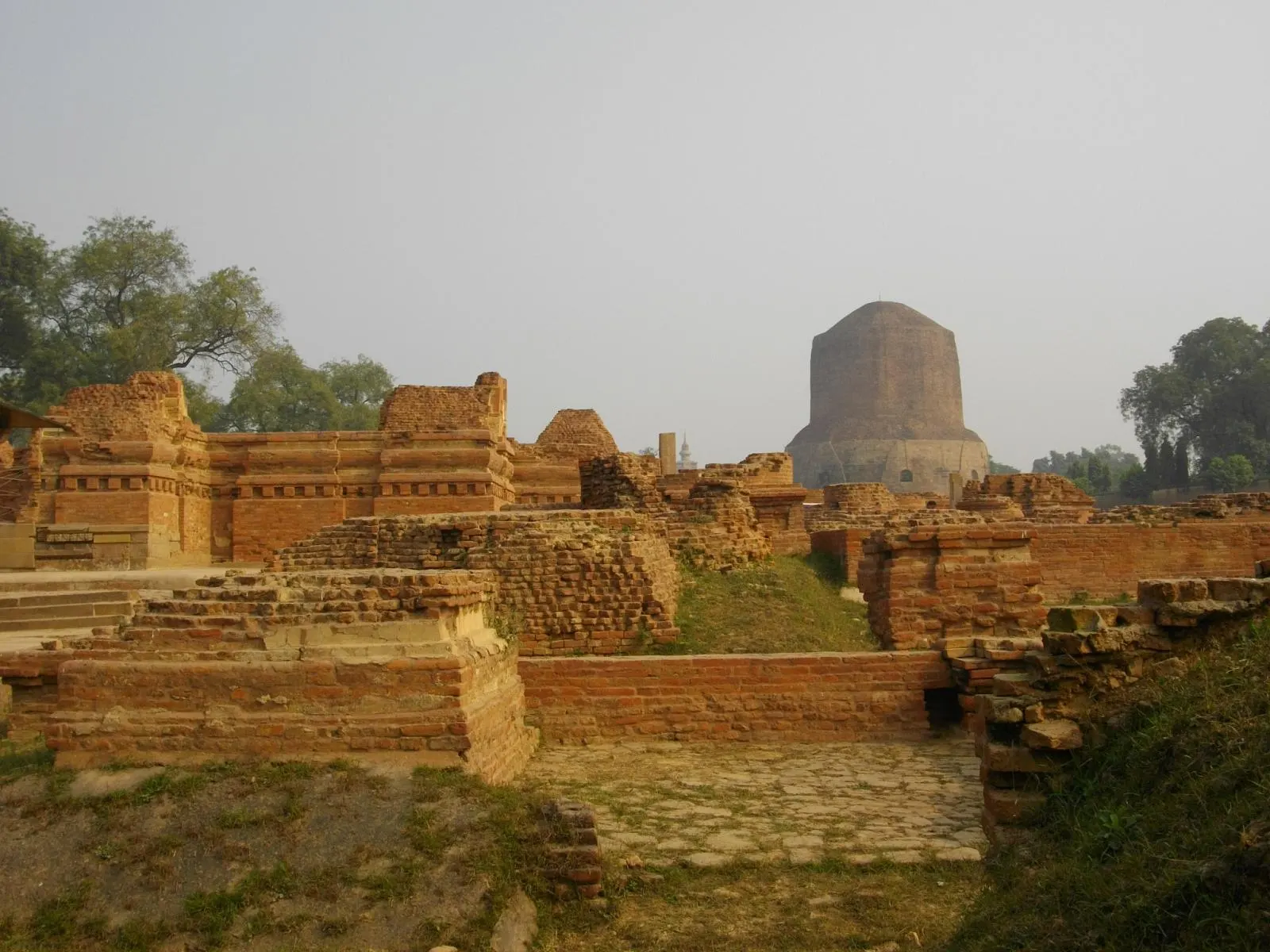
After his enlightenment at Bodh Gaya, the Buddha walked some 250 kilometres to the deer park at Isipatana, found the five ascetics who had abandoned him, and taught them the Middle Way and the Four Noble Truths. Sarnath is that deer park. Ashoka came in the third century BCE and built the first stupas and a pillar with four lions on its capital; the lions are now in the Sarnath Archaeological Museum, one of the finest small museums in India, polished to a mirror sheen after 2,300 years, with the stump of the pillar still standing in the excavated monastery ground.
The Dhamek Stupa, 43 metres high and rebuilt in the Gupta period, carries a band of carved lotus and geometric patterns at the height of a walker's eyes; in the evenings monks from Sri Lanka, Thailand, Tibet and Japan circle it chanting. Nearby is the ruined Dharmarajika Stupa, the Chaukhandi Stupa where the Buddha met his disciples, and the Mulagandha Kuti Vihar, built by the Mahabodhi Society in 1931, with a Bodhi tree grown from a cutting of the Anuradhapura tree and murals by the Japanese painter Kosetsu Nosu. Modern monasteries from each Buddhist nation line the roads, and the Thai temple has an 80-foot standing Buddha.
Sarnath is quiet where Varanasi is loud; give it a slow morning, read the sermon under the trees, and come back for the museum when it is cool.
 Street food