Thrissur is built as a ring: the Thekkinkadu Maidan, a raised mound of teak at the centre, with the Vadakkumnathan temple on top and the Round, a circular road, wrapped around it. The temple is among Kerala's oldest, a walled complex of low tiled roofs, a koothambalam hall for ritual drama, and murals darkened by generations of lamp oil; only Hindus may enter, and men must be bare-chested in a mundu. Around this hub the city keeps Kerala's cultural machinery running, with the Sangeetha Nataka Akademi and the Sahitya Akademi in town and, thirty kilometres north at Cheruthuruthy, Kalamandalam, where students of Kathakali, Mohiniyattam and Koodiyattam begin training before dawn.
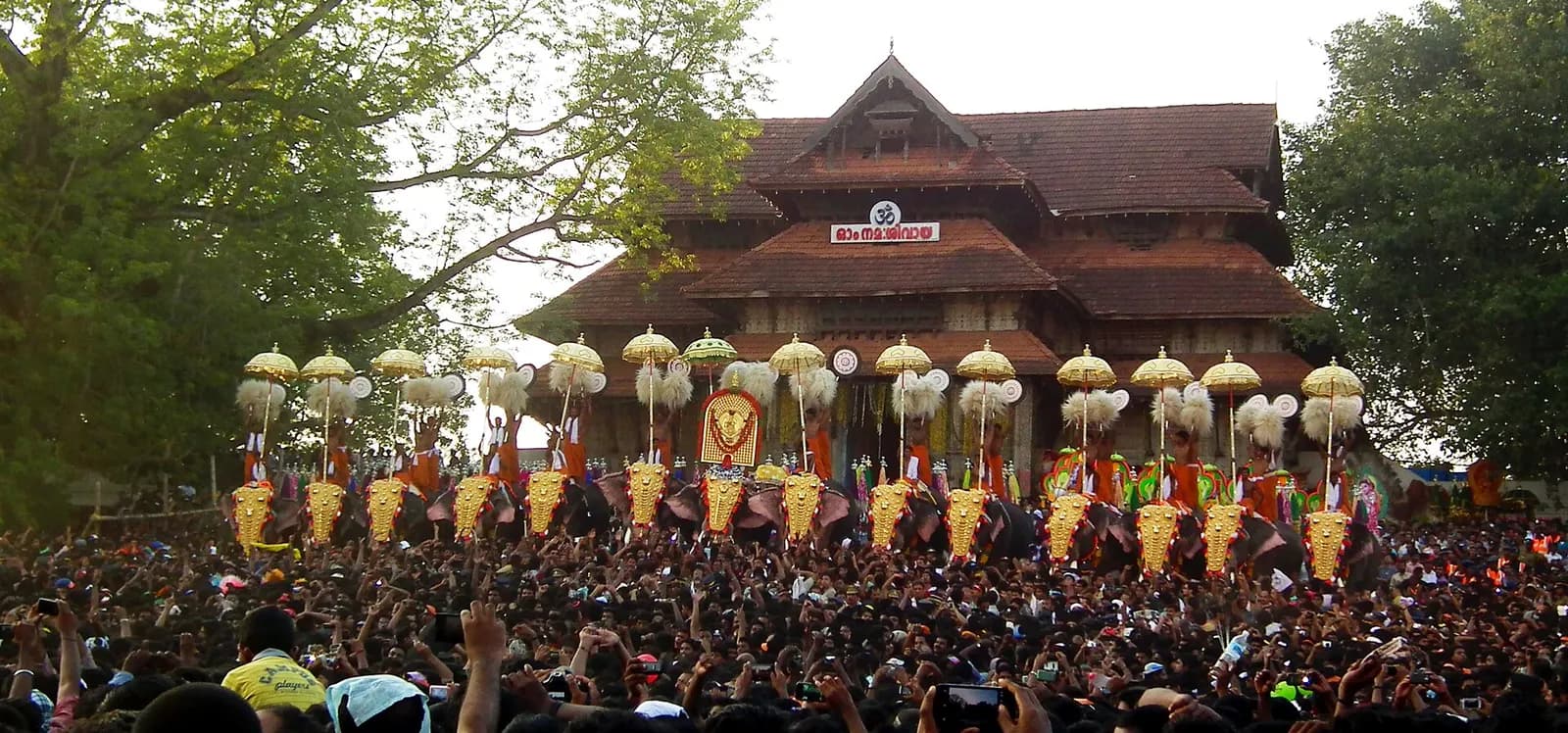
Everything builds to one afternoon. Thrissur Pooram, organised by Sakthan Thampuran around 1798 and held in the Malayalam month of Medam, usually late April or early May, sets the Paramekkavu and Thiruvambady temples against each other in a thirty-six-hour contest: thirty caparisoned elephants facing off across the maidan, the Ilanjithara Melam played by some two hundred and fifty drummers and pipers, the kudamattam exchange of silk parasols in the late afternoon, and fireworks in the small hours that rattle windows across the district. On ordinary days, Guruvayur's Krishna temple lies thirty kilometres west and the eighty-foot Athirappilly falls sixty kilometres east.
 Vegetarian