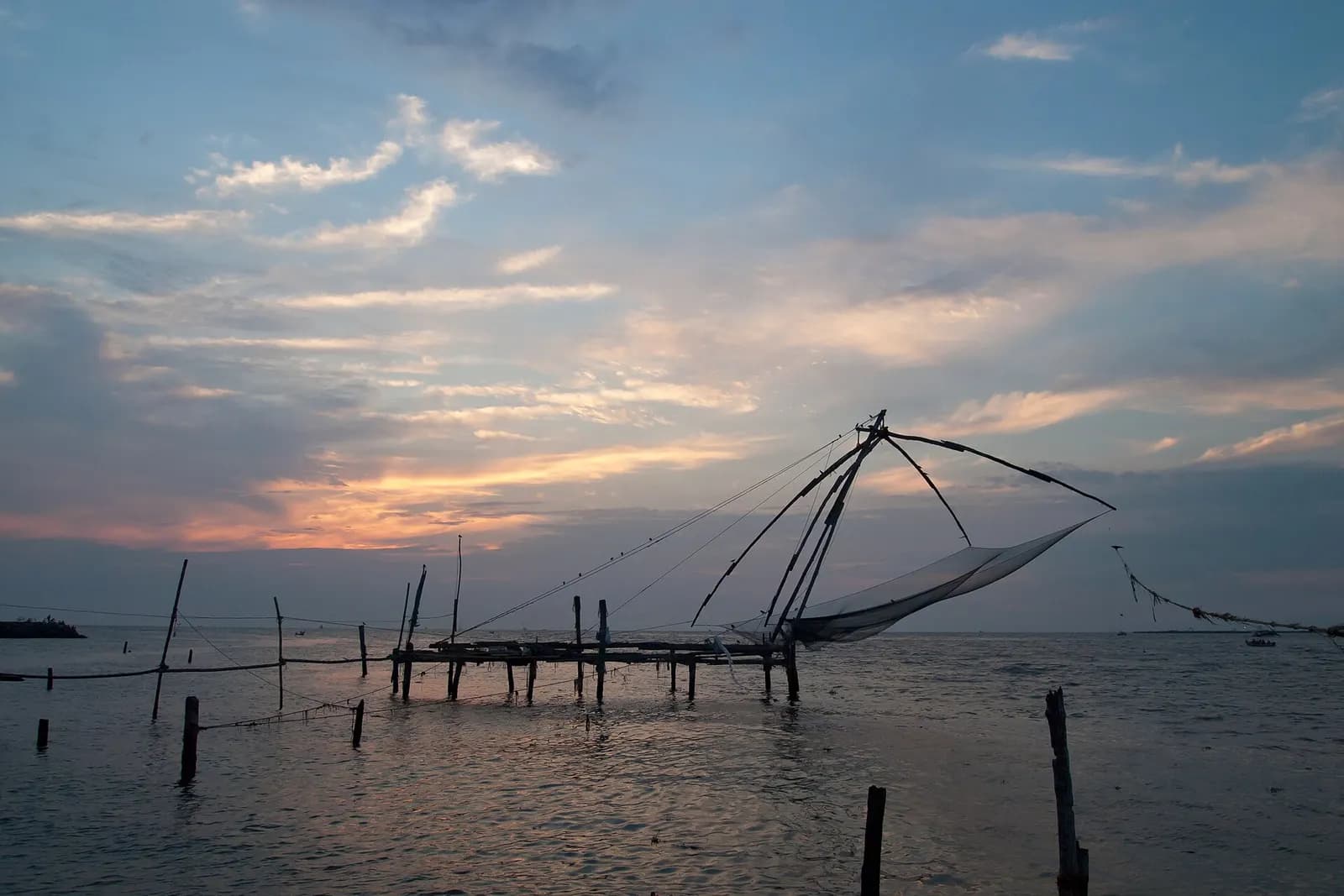
Kochi became a port by accident: the flood of 1341 silted the Periyar's old mouth and opened a natural harbour, and within two centuries Arabs, Chinese, Jews, Portuguese, Dutch and English had all set up shop on it. Fort Kochi still shows the layers. The cantilevered Chinese fishing nets on Vasco da Gama Square are lowered and hauled by teams of four men and a counterweight of stones.
St Francis Church, built in 1503, is the oldest European church in India and held Vasco da Gama's body for fourteen years before it was taken home to Lisbon. Ten minutes away in Mattancherry, the Paradesi Synagogue of 1568 has a floor of hand-painted Cantonese tiles, no two alike, and Belgian chandeliers below a clock tower added in 1760; the lane outside is antique dealers and spice godowns that still smell of ginger and pepper. Next door, the Dutch Palace holds some of the finest murals in Kerala, a Ramayana running across a bedroom wall.
Days here are slow and walkable: coffee in a homestay courtyard, the Dutch cemetery wall, a Kathakali performance you reach an hour early to watch the make-up go on, then grilled seafood chosen off the ice beside the nets. Every second winter the Kochi-Muziris Biennale fills Aspinwall House and half the neighbourhood with contemporary art.
 Vegetarian