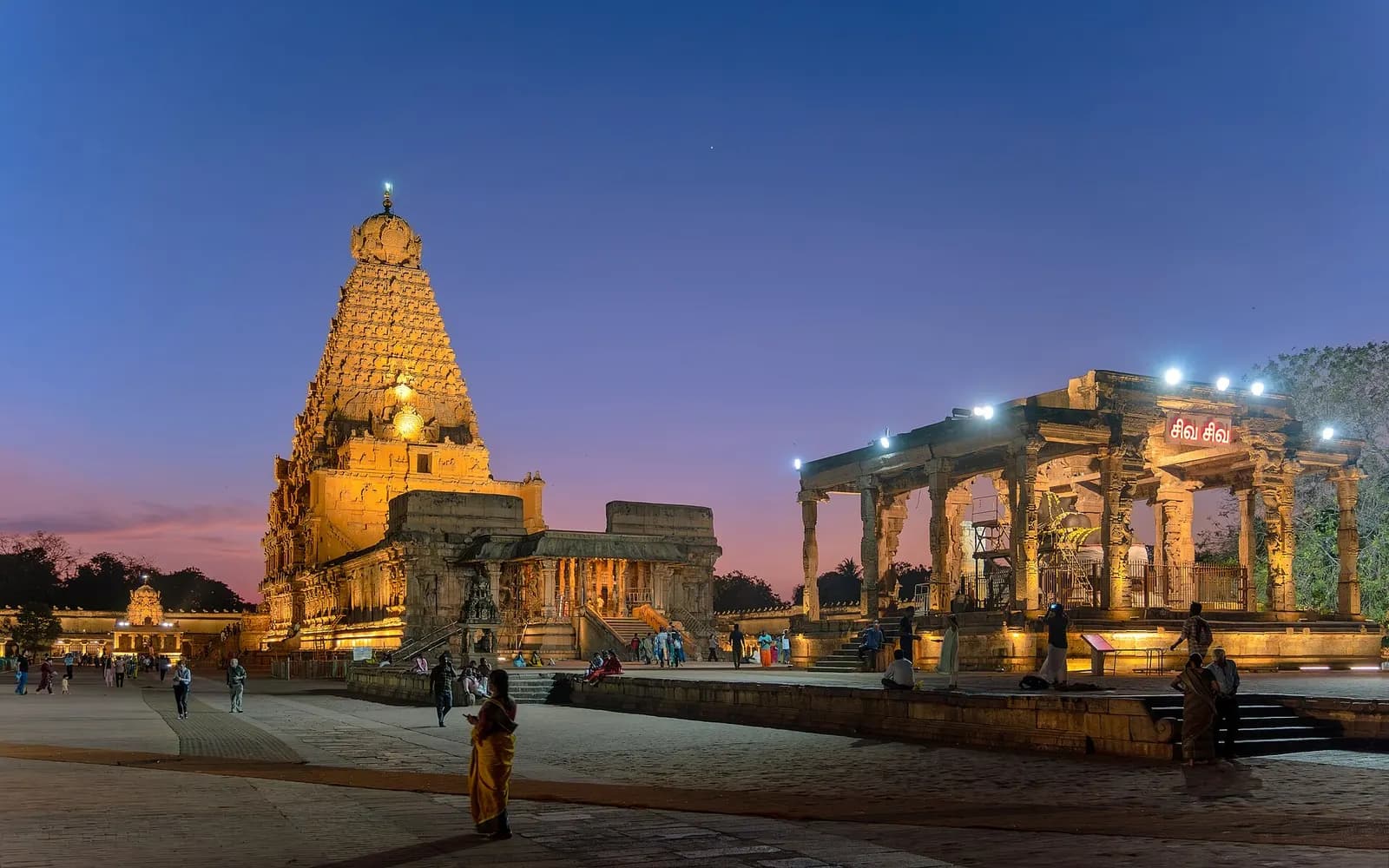
Thanjavur sits in the Kaveri delta, on soil so fertile the Cholas could fund an empire from it, and the temple Rajaraja I consecrated in 1010 is the plainest proof of that wealth. Called Peruvudaiyar Kovil locally, the Brihadisvara has a vimana of about 66 metres built entirely of granite hauled from far outside the delta, capped by an enormous crowning stone and guarded by a Nandi cut from a single boulder six metres long. Its walls carry inscriptions listing the dancers, musicians, lamp oil and whole villages endowed to it, and an inner corridor keeps eleventh-century murals of Shiva and the king, rediscovered beneath later Nayak paint.
It is one of three Great Living Chola Temples on the UNESCO list, with Gangaikonda Cholapuram 70 kilometres north and Airavatesvara at Darasuram 35 kilometres away near Kumbakonam. The other Thanjavur is Maratha: the sprawling palace of the Bhonsle rulers, part ruin and part museum, whose art gallery holds Chola bronzes of a quality you will not see elsewhere, and the Saraswathi Mahal Library with its palm-leaf manuscripts. Craft carries on in the town and at Swamimalai nearby, where icons are still cast by the lost-wax method, and in workshops where gold foil and semi-precious stones go onto Tanjore paintings.
Go to the temple at dusk, when the granite turns pink and the lamps come on.
 Drink
Drink