For a century and a half Old Goa was the capital of the Portuguese seaborne empire in Asia, a city of some two hundred thousand people that Europeans called the Rome of the East, with more churches to the street than Lisbon. Then cholera and malaria emptied it, the administration moved downriver to Panjim in 1843, and the jungle took the houses. What is left is a strange and beautiful field of churches standing alone on lawns, listed by UNESCO in 1986.
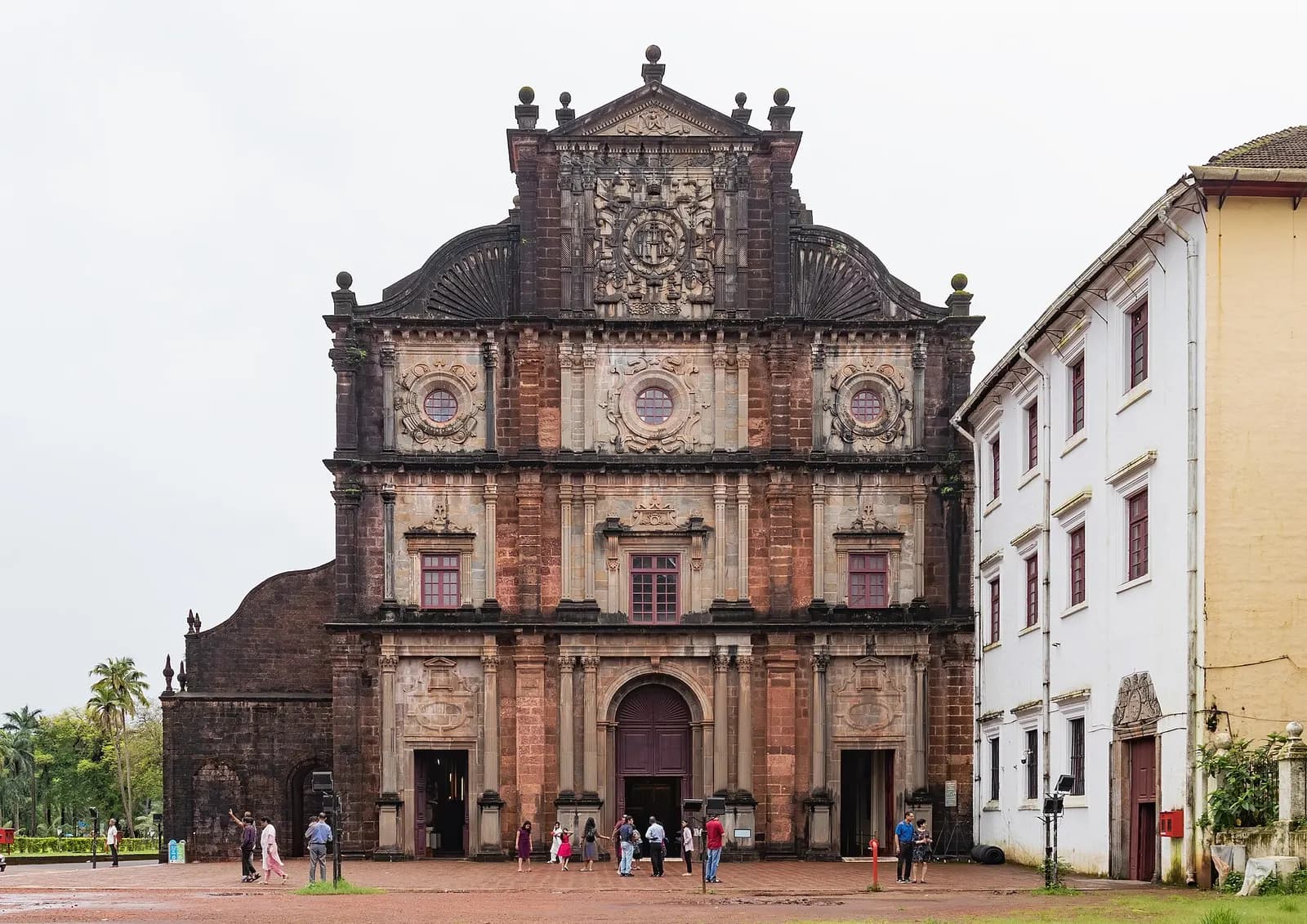
The Basilica of Bom Jesus, finished in 1605, is the one everyone comes for: unplastered laterite outside, gilt and carved wood within, and in the right transept the marble and jasper mausoleum given by a Medici duke that holds the body of St Francis Xavier, brought back from the China coast in 1554 and shown in public only once a decade. Across the road the Se Cathedral is the largest church in Asia, its surviving tower carrying the Golden Bell whose ring once summoned the Inquisition. Behind it, St Francis of Assisi has a painted wooden interior and an archaeological museum of viceregal portraits.
Walk further and you find St Cajetan modelled on St Peter's, the Viceroy's Arch by the old jetty, and, on a hill, Our Lady of the Mount, empty and silent, with the best view of the ruined capital.
 Non-veg