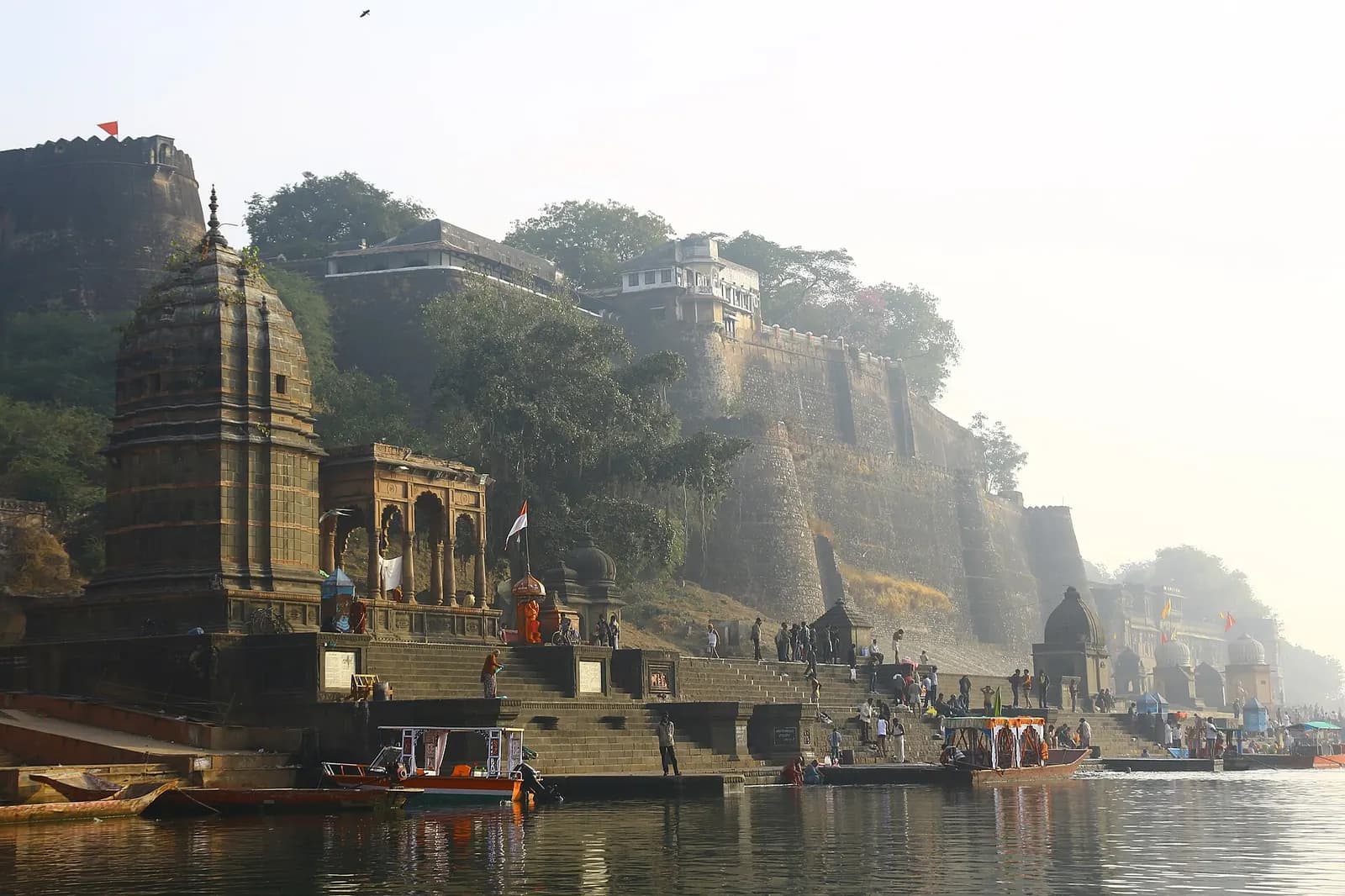
In the Mahabharata this was Mahishmati, capital of the thousand-armed Kartavirya Arjuna; in history it is the town Ahilyabai Holkar chose as her capital in 1767 and ruled for 28 years, a widow who built temples across India while governing Malwa with a reputation for justice that is still recited here. Her fort, the Rajwada, rises straight from the river; inside are her plain durbar, her palanquin and a small shrine with her image, and the Ahilya Fort hotel run by her descendant Richard Holkar. Below, the Ahilya Ghat and the Peshwa Ghat are lined with stone lions and carved balustrades, where pilgrims bathe, women wash cloth and boatmen wait beneath the walls.
The Ahilyeshwar temple and the chhatris of the Holkars sit on the fort terrace, their carving crisp Maratha work. The other industry is on the looms: Ahilyabai brought weavers from Surat and Mandu, and the Rehwa Society, founded in 1979, keeps the tradition alive, weaving the light cotton and silk sarees with reversible borders that you can watch being made and buy at source. Take a boat at sunset to Baneshwar, a tiny temple on a rock in mid-river that tradition places on the axis of the pole star, and again at dawn when mist hangs over the water.
Sahastradhara, 5 km downstream and reachable by boat from the ghats, is where the Narmada braids into a thousand channels through black rock. Mandu is 40 km up the ghat and Omkareshwar 65 km upstream.
 Street food