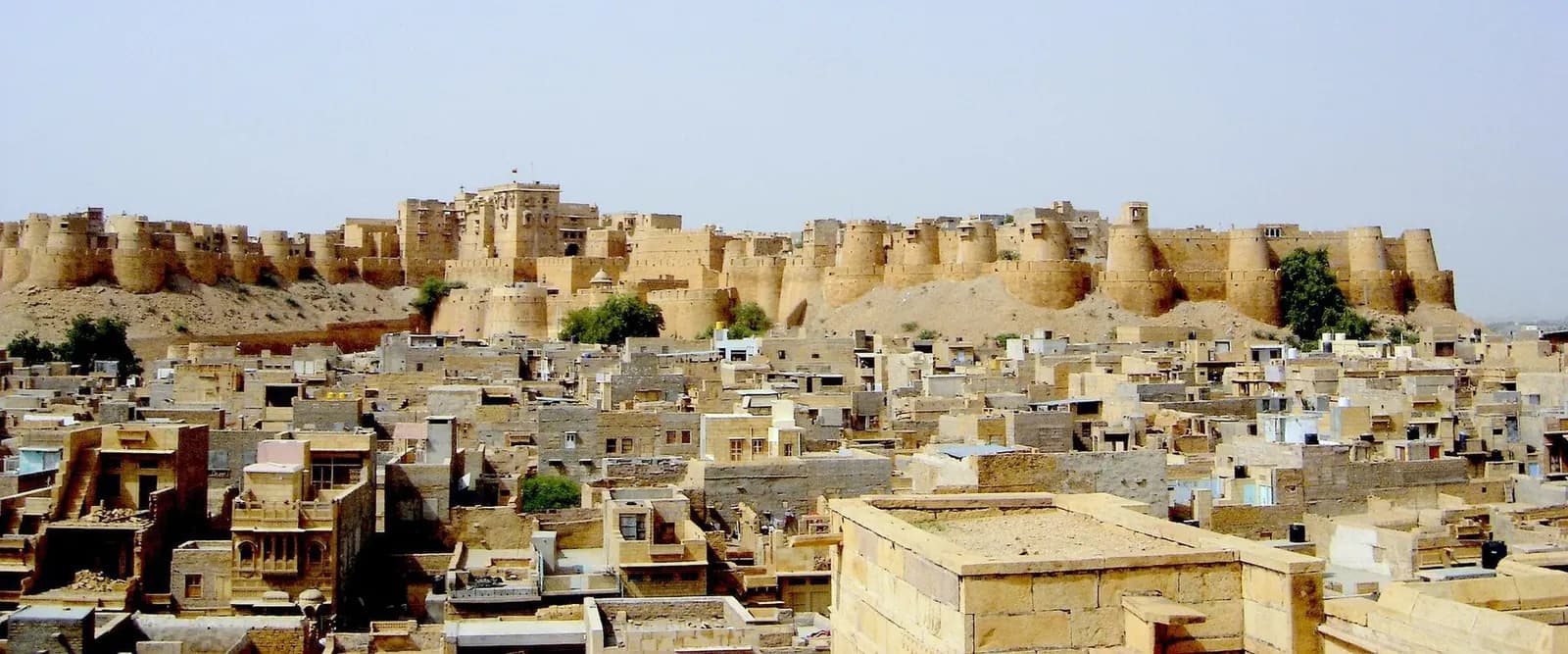
Jaisalmer glows because everything in it is cut from the same yellow sandstone, from the 99 bastions of the fort to the lattice screens of the havelis. Rawal Jaisal founded the fort in 1156 on the caravan route between Sindh and Delhi, and the Bhati rulers and Jain merchants who prospered on that trade built the town's finest stone: the Jain temples inside the fort, carved between the twelfth and sixteenth centuries, and Patwon ki Haveli, five houses joined into one from 1805 onward, their balconies dense as lace. Nathmal ki Haveli was carved by two brothers working from opposite ends, and the halves do not quite match.
Gadisar Lake, the town's old reservoir, is best at dawn when catfish crowd the ghats. Bada Bagh's royal cenotaphs and the abandoned village of Kuldhara, emptied in the 1820s, lie on the road west to the Sam dunes, 42 km out, where the camel rides and folk music happen at sunset; Khuri, to the south-west, is quieter. The Desert National Park nearby protects the last great Indian bustards.
Jaisalmer is a frontier town too: Tanot Mata temple and the Longewala battlefield of 1971 are two hours toward Pakistan. The Desert Festival every February brings turban-tying, moustache contests and camel polo to the sands.
 Vegetarian